
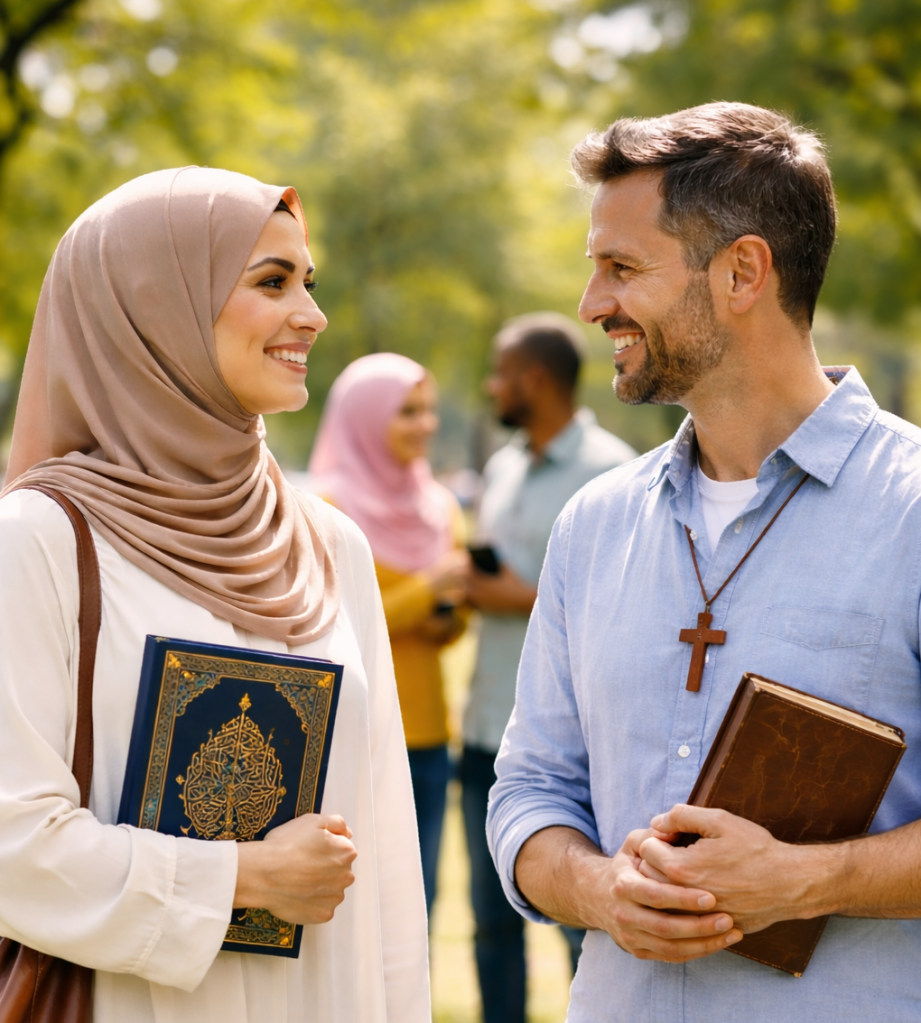
According to Open Doors, an organization that tracks Christian persecution around the world, Christians are among the most persecuted religious groups on earth. It is a well-documented reality that most Western Christians rarely think about. And we should think about it, because these are our brothers and sisters in Christ who sometimes feel forgotten by the Western Church.
I understand that Western society makes pluralism possible, and we now live in a post-modern culture where truth has become relative, and everyone gets to define what truth is.
Don’t get me wrong, I am all for respecting people and refusing to hate them for their religious beliefs. But respecting is not the same as affirmation. As a Christian, you are NOT called to affirm every belief system equally.
Christ doesn’t leave room for that kind of neutrality!
The God of the Bible is jealous, and He makes it very clear: anyone who worships another god is not worthy of Him and will be taken out of the book of life.
Jesus is the ONLY way to the Father, and that truth is not relative in Christianity.
No, not all roads lead to God, and no, we don’t all worship the same God.
If you are a Christian who believes that people should be left to practice their religions, with no desire on your part to share the Gospel, I would gently ask: when did you last take that question to God in prayer?
Why do you have a hard time standing up for what you believe without offending people? How can you love your Muslim neighbor without affirming their belief system, yet live a life that draws them to the Gospel?
The answer is not as complicated as you might think.
Now, let’s first look at Christianity in Muslim-majority countries.
There are nearly 50 Muslim-majority countries in the world, and they vary enormously in language, culture, traditions, and in how Islam is practiced. Some are relatively secular. Some are very conservative, and some sit somewhere in between.
But nearly all of them share one thing, and that is the fact that Christians do not have full religious freedom.
In the most extreme cases, being a Christian is dangerous. Open Door’s World Watch List consistently places Muslim-majority nations, with North Korea being the only exception most years, at the top of its persecution index. In countries like Afghanistan, Somalia, Libya, and Yemen, openly identifying as a Christian, let alone sharing your faith, can cost you your life.
In others, Christianity is tolerated within limits. You may attend a church service, but you may not evangelize. You may hold private faith, but you may not invite others into it.
You can be Christian, not too Christian.
The moment your faith becomes public and missionary in nature, you lose the protection of tolerance.
It is worth remembering that the Middle East was once predominantly Christian. The rapid and sometimes violent spread of Islam beginning in the 7th century, through conquest, heavy taxation that economically disadvantaged non-Muslims, and social pressure over centuries, transformed that region dramatically.
Muslim-majority countries do not tolerate pluralism the way you may think. Christians may have the freedom to worship in some of them, but it is constrained and monitored.
And no, Christians are never fully safe, even in the most modern and secular Muslim society. Because even the most secular Muslim society has a group of Muslims whose beliefs are more extreme than others, and they take apostasy as seriously as Muhammad did.
Muslims living in the West
The situation looks very different in Western nations. The West is largely built on principles of religious liberty, so Muslims living here are generally free to practice their faith, build mosques, and express their beliefs publicly. Many have come precisely because of that freedom, fleeing economic hardship, political instability, or religious persecution in their countries of origin.
It is worth noting that Muslim communities are not monolithic. Muslims also persecute other Muslims — Sunni and Shia tensions, along with the treatment of minority sects, reveal that the problem of religious intolerance is not simply Islam-versus-others. It runs through Islam itself.
For Christians in the West, Muslims are our neighbors, our coworkers, our classmates, our doctors, teachers, and lawyers. The question of how to relate to them is immediate and practical.
The issue for me personally arises when I see some Muslims immigrants taking the freedom of religion that the West offers for granted, demanding accommodation while showing little respect for the very society that granted it. I also struggle with cases where the same people who flee their countries for economic opportunity or general freedom develop hostility toward Western ideology, which has been influenced by Christianity.
They resent it when their children become “too Western” — when they choose not to practice Islam, or move away from certain aspects of their parents’ culture. My question is: Why have children in the West and continue living here if you don’t want them to become Western? If you want them to remain fully rooted in their original culture, then why not stay in the country you came from?
I live by two simple principles: be grateful for what you have been given, and never bite the hand that feeds you.
But my frustration does not end there. I often find myself annoyed with liberal Christians or just liberal people in general who defend the rights of Muslims to worship freely, noble in theory, yet condemn conservative Christians for holding a biblical worldview. They attack Christians for opposing abortion and for affirming traditional marriage, while simultaneously praising Islam — a belief system that punishes both abortion and homosexuality far more severely than any conservative Christians ever have.
That’s the kind of paradox that drives me mad.
And it tells me that many in the West don’t just disagree with Christianity, they despise it. Sometimes when I think about how much people hate Christianity and Jesus, I become overwhelmed with the fear of the Lord, not fear for myself, but for them. Knowing how holy and just God is, I genuinely fear for what will happen when His justice is finally revealed.
I fear that our culture’s embrace of religious liberty is leading us down a dangerous path. Scripture teaches that when a people group persistently rejects the God of the Bible, He withdraws His hand of protection and allows them to reap the consequences of their choices.
A nation that turns away from God does not simply drift — it gets destroyed.
How Christians should approach Islam?
The answer begins with a firm distinction: for the person, and no theological compromise of the truth.
Christianity is not a relativistic religion. We do not believe that all paths lead to heaven, or that moral decency is a sufficient substitute for the atoning work of Christ. The resurrection is not a metaphor or one tradition among many — it is the hinge on which everything turns. Without it, as the Apostle Paul writes, our faith is worthless.
Love, in the Christian sense, is not tolerance. Love is telling people the truth with love to save their souls from the pit of hell.
That said, this is not a call for hostility. Shouting at strangers, mocking Islam online, or engaging in performative debates designed more to win than to witness, none of that is the commission Christ gave us. The early church did not spread across the immoral Roman Empire by accommodating paganism in the name of cultural relevance. It spread because ordinary believers lived differently and spoke truthfully.
Pluralism, in its secular form, allows every ideology to exist on equal footing with no one making exclusive claims.
That is NOT the Gospel!
Christians can and should live peacefully with their Muslim neighbors. We can share meals, share friendship, and share genuine respect. But we cannot share the pretense that it does not matter whether someone knows Christ.
This is not a call to hate.
It is a call for Christians to wake up, take their commission seriously, and love their Muslim neighbors enough to tell them the truth.
 Fariza
Leave a comment