
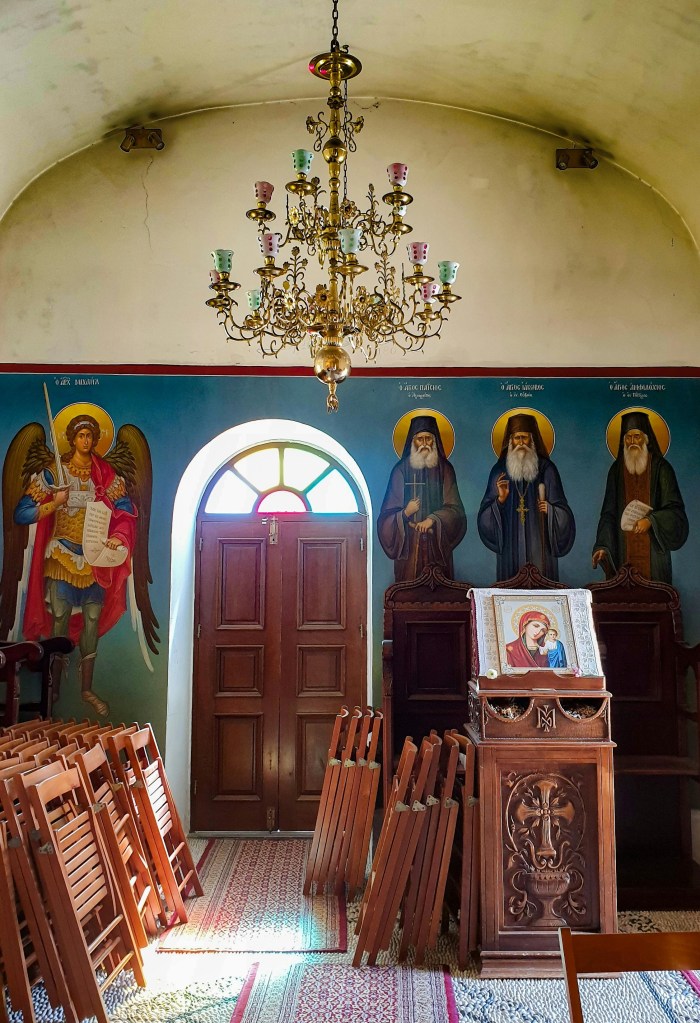
“Wait…those are his relics? By the exit of the sanctuary? That’s The Saint Raphael of Brooklyn?” I asked, half confused and half fascinated.
I paused, trying to piece it all together. “I thought he was buried somewhere on the property. I had no idea they placed his remains inside the church. That’s so weird…Also, I’m not sure if this is appropriate to say, but his skull is really small. Is that what our skulls look like once we die?”
My friend chuckled and said, “I guess that’s how big our heads actually are.”
“So interesting… Eastern Orthodoxy is blowing my mind every day, “ I replied as we exited the chapel.
It was the morning after my friend and I had driven five hours from New York City to Pennsylvania, to the Antiochian Village, for a conference that gathered Eastern Orthodox believers.
Everything felt surreal, like I stepped into an ancient world in modern times.
If you had told me a year ago that I would be praying to the Virgin Mary (or Mama Mary, as I prefer to call her) and venerating the relics of saints, I would have laughed and said you were crazy. “I don’t pray to images, statues, or dead people.”
And yet, here I am, doing it all.
Who would have thought that one Sunday, during worship at my non-denominational church, God would give me a vision ofChrist Pantocrator, and gently whisper to my soul, “It’s time?”
A few weeks later, I walked into my first service at an Eastern Orthodox church in Brooklyn. The moment I stepped into the sanctuary, I knew immediately that I was home.
Who would have thought that later that year, I would be commemorating St. Raphael of Brooklyn on his feast day, spending five hours on my feet listening to Byzantine chants, smelling incense, and praying inside the jewel that is the Antiochian Orthodox Church?
Did I understand everything that was happening? No.
But did I feel like I was home in heaven? Yes.
The Feast of St.Raphael of Brooklyn
WILD…I know!
For a rational, reason-loving, mostly Western-minded Protestant gal like me, this has been a humbling, slightly disorienting, and completely life-changing experience.
Never in a million years did I think that after visiting a village in Pennsylvania and venerating a dead man’s bones, he would show up in my spirit while I sat in the dentist’s chair getting my teeth cleaned. I had two choices: ignore the experience or ask St. Raphael to pray for me to ease the pain of the dental drill piercing my gums.
I chose the latter — and it worked!
Before I knew it, my dentist had finished the procedure, and I was on my way home — shooketh to my core, eager to tell the priest, and pleasantly surprised that my prayer had been answered so quickly.
That day marked the beginning of my relationship with Saint Raphael of Brooklyn. It was the day I placed his image in my little icon corner and started asking for his intercession daily.
Over time, I sensed that his prayers had guided generations of immigrants in the United States into the depths and beauty of the fullness of the Christian faith.
And this fellow immigrant was included on that prayer list.
When I first heard the story of St. Raphael, it moved me in a way I couldn’t explain. His life felt strangely familiar. He was an immigrant, just like me, a man who left his home not once but twice to follow God’s call. Our stories similarly stretch from East to West.
Raphael Hawaweeny was born into a Syrian family in Lebanon, who later moved to Russia, eventually answered a call that brought him to the United States, to New York City. There is one particular story from his life that stayed with me while I was researching his life. When St. Raphael first arrived in America, he traveled on foot all across the country, knocking on people’s doors and asking if Orthodox Christians lived there. If they did, he offered them communion, confession, prayer, and even baptizing babies. What makes this story so compelling is that he carried out this mission with almost no resources, little sleep and comfort, and no real stability — only obedience.
He had the Lord, and that’s really all you need in life.
In different centuries, St. Raphael and I faced the same quiet trials of immigration: language barriers, cultural dislocation, isolation, and the aching question of where we belong. What anchors him anchors me, too, and that is the conviction that we go where God sends us. When the Lord says, “Go,” we go. Even when fear argues for comfort, even when things don’t make logical sense, even when we don’t have enough resources, we must obey.
We go because we know that the Lord is good, and His purposes are always good, not only for us but for the people we are sent to serve.
In On the Steadfastness of the Orthodox Church, St. Raphael wrote,
“If we skim through reliable history, we come to know that the Church of Christ, since its foundation until now, that is, in the course of about nineteen centuries, did not rest in any century from the great struggle against the many who war against Her and the numerous who resist Her, both Jews, pagans, heretics, and atheists. At the same time, however, we also recognize that victory, in every place and time, was the ally of the Church’s luminaries and will accompany Her until the end of days, according to the witness of Her divine founder, our Lord and God Jesus Christ, who built Her on the rock of faith in Him and said: “The gates of Hades shall not prevail against Her.”
The gates of hell indeed will not prevail against the Bride of Christ!
And if that is true, then no piece of paper, no governing authorities, no dark powers can determine the worth of an immigrant. We bear the image of the One who created all things, and that alone makes us worthy, a dignity that cannot be granted or taken away.
It’s interesting how, sometimes, God gives us full-circle moments in life. Growing up as a Muslim in a Muslim country that was once occupied by communist Russia, I didn’t have a very positive perception of the Russian Orthodox Church. To me, Christianity was associated with Orthodoxy, and any Russian I met I automatically assumed was Orthodox. So when I saw my people being mistreated in Russia, or witnessed how some Russians lived and behaved in my country, all of that was projected onto Orthodoxy itself.
Fast forward to today, and my heart and mind have been transformed by the Eastern Orthodox Church. I have experienced miracles and healing that I had prayed for years while in a Protestant church. St. Raphael’s intercessory prayers have guided me on the journey of getting closer to God, and I trust him because he knows what it means to leave everything familiar behind and follow the call of God on one’s life.
St. Raphael gets me, and I love him for it!
Now, am I still bothered by the way Russians sometimes treat my people? Absolutely, yes. But do I think Orthodoxy is to blame? Absolutely not.
The Church is a hospital. It is also a home, and God would never force us into that space without our consent. God is merciful, gentle, powerful, and infinitely loving. He is wise and patient. He could wipe us off the face of this planet if He wanted to because, let’s face it, human beings are pretty terrible. But God is way too merciful and forgiving to do that again… at least for now. So He gives us the time and the opportunity to come to Him. He gave us the Church, the saints, and the entire cosmic and earthly Body of Christ, so that we might experience the fullness of our supernatural faith and taste heaven. God gave us friends and family, both here on earth and in heaven.
The saints love us so much that they constantly pray for us.
The stories of the saints will always humble me and put things into perspective whenever I get caught up in the messiness of this world. Their lives are a lamp to my feet. Had it not been for their obedience and their willingness to do the Lord’s will here on earth, I don’t know where we would be today.
St. Raphael of Brooklyn has a special place in my heart. Maybe it’s because we are both immigrants. Maybe it’s because we are both Eastern and lived in Russia at some point in our lives. Or maybe because we are both honorary New Yorkers, the title that most of us carry with pride. Or maybe it’s because we carried the weight of being foreigners, yearning to go to a place where we truly belong — the presence of our Heavenly Father.
I don’t know…
But one thing I do know: I got to know him, and he has helped me and continues to intercede for me before Jesus.
Perhaps this is how God works. His work often hides inside ordinary people, who are crossing borders and cultures, and it takes us a long time to recognize that.
So, let us be kind and welcoming to immigrants and strangers, because you never know whether you are being kind to a future saint or to an angel of the Lord (Hebrews 13:2).
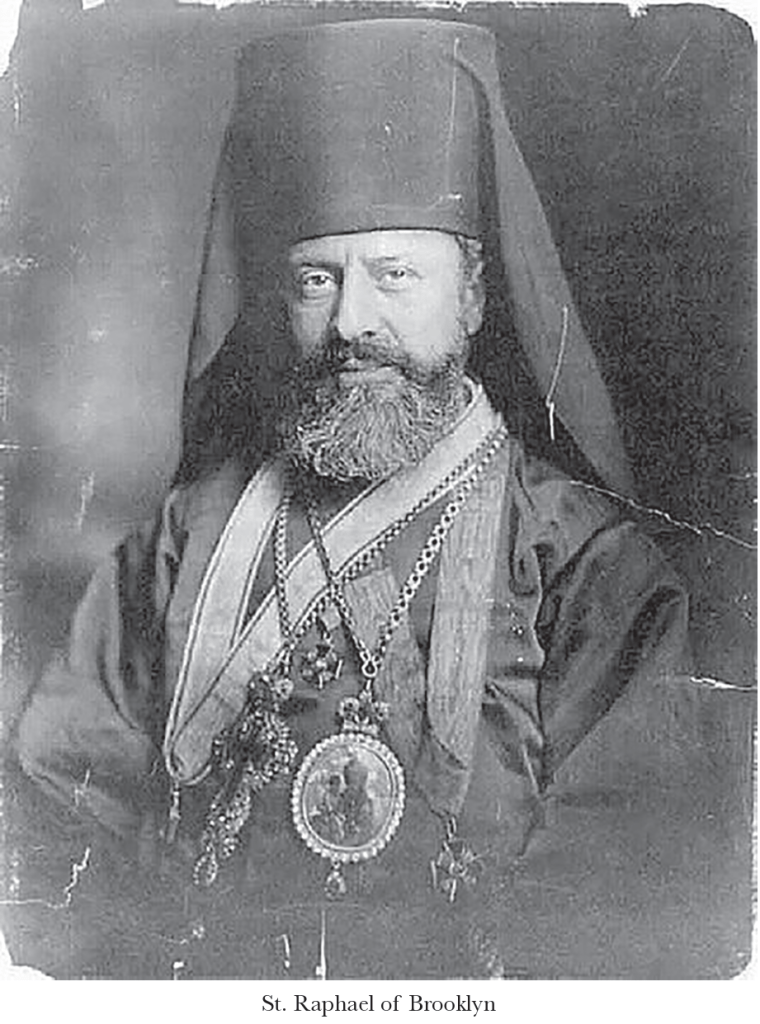
Saint Raphael of Brooklyn was formally canonized as a saint by the Holy Synod of the Orthodox Church in America on March 29, 2000. He made history as the first Orthodox bishop consecrated on American soil, a milestone that took place in 1904. The Church primarily commemorates him on February 27, the date marking his repose in 1915.
 Fariza
Leave a comment