I don’t really go to the movies for the movies anymore. I go for the giant recliners that feel like a hug. I go to fancy movie theaters for the food, the mocktails, and the vibes. I go to spend quality time with my friends.
The reason going to the movies to watch a movie no longer excites me is that almost everything Hollywood has produced in the last decade has genuinely sucked.
I know this because I used to live in LA, where all my friends were somehow in “the industry.” Some were actors, some producers, some accountants, and assistants working in movie production, all waiting to be discovered. They would tell me stories about the industry and how cutthroat it was. That’s when it hit me: Hollywood is a business. The supply is low, the demand is high, and the budget is limited. Too many people want to be famous, and not enough money is being invested in making real art. Hollywood is also a small, tightly knit community where nepotism is common. The elites don’t like sharing the spotlight.
It’s all about who you know and who you are willing to sleep with.
I mean, it’s like this in most industries, but Hollywood feels like an exception; it operates more like a mafia or a secret society than an industry that’s supposed to tell meaningful stories on a screen. And it makes sense why every time I open a streaming platform, it takes me forever to choose a movie. I often catch myself thinking, Why would anyone produce this crap? This is a terrible film. What a waste of money and talent. But somehow someone read that awful script and said, “Yes, let’s invest money in this one.”
Then I remind myself that mediocrity exists everywhere — bad lawyers, bad doctors, bad teachers, bad CEOs. The list goes on. What’s rare is excellence.
Exceptional art is rare.
People who are truly great at what they do are rare.
I have met those people in LA, the widely talented ones, and I would secretly grieve knowing the world would probably never see their magic because they actually have morals.
And now, enter AI, stage left, ready to blow up this already dysfunctional party. We are either about to enter a wild new era of filmmaking or watch the whole thing implode. Honestly, I’m surprised there aren’t more movies about AI out there. I think it’s because we are still collectively suspicious of it, trying to figure out if it’s our new best friend or an enemy waiting to devour humanity. The government is still trying to figure out whether it should be regulated. Some people are terrified of it, while younger generations have fully embraced it; the innocent have lost lives to it, and we are already seeing its impact on our mental health.
We are at a crossroad. We either submit to AI completely or try to eradicate it altogether.
Where we go from here is up to us.
Which brings me to Mercy, the new Chris Pratt thriller. I went in expecting the usual, but I left feeling…seen.
First, a confession: I had no idea it was directed by “The” Timur Bekmambetov until the credits rolled. My fellow former-Soviet heart sank a little. He is our pride! The first Russian-Kazakh to direct Hollywood blockbusters! To be honest, had I known he directed it, I would have had higher expectations. I would have expected more fireworks, more action, more mind-blowing plot twists, and better visuals. This one did not deliver any of that.
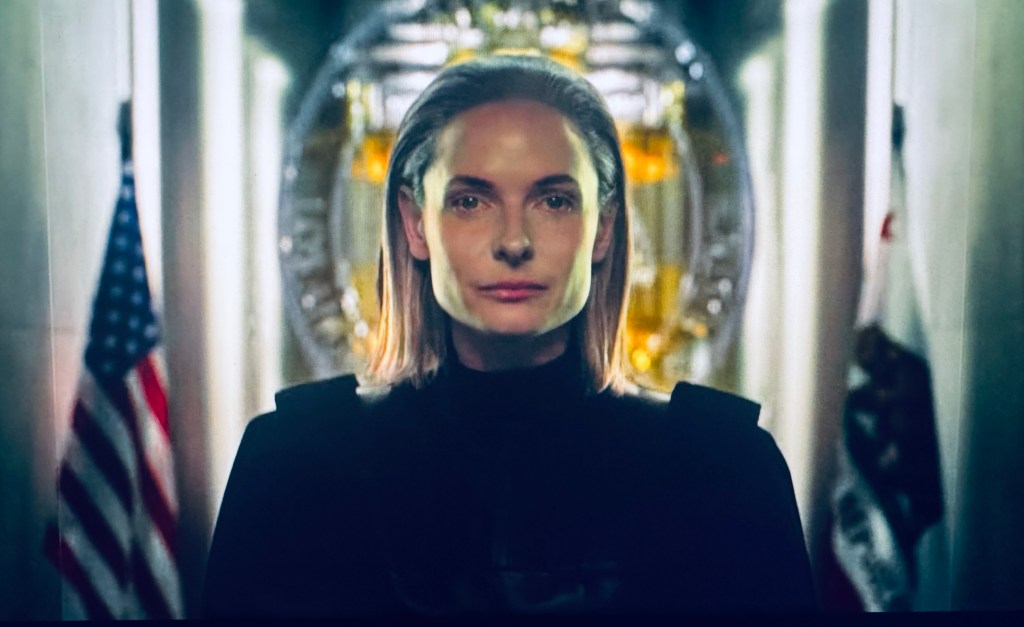
Plot-wise, Mercy is fine. It’s a bit boring. But the best part, the only part that mattered, was Mercy herself. The AI judge, played with perfection by Rebecca Ferguson.
Now, Spoiler Alert: You can skip this section. I’m about to reveal the entire movie.
The gist: Detective Chris Raven (Pratt) wakes up in a dark room, strapped to a chair in front of a giant computer screen. He is in an AI courtroom. He has one hour to prove he didn’t murder his wife. If he fails, the AI-generated judge executes him right on that chair. A screen shows his probability of guilt as a percentage. His only job is to bring that number down.
At first, he does the human thing. He pleads, he yells, he says he is a detective, for God’s sake, he puts other people in this chair! Mercy doesn’t care, or shall I say, is incapable of caring. She doesn’t operate this way. She only responds to facts, data, and logic. She begins by showing him the evidence: his DNA, footage of him fighting with his wife, getting drunk, starting a fight at a bar, and blacking out. He admits to having issues (his partner was killed in front of him), but Mercy registers that as evidence to raise the percentage of guilt barometer. Emotion is not a relevant data point. If anything, it makes him look guiltier.
So then his detective brain finally kicks in. He starts using Mercy the way she’s supposed to function. “Mercy, pull up traffic cam footage from that night. Cross-reference with police dispatch logs.” She does it with precise accuracy, pulling out stats, pictures, and videos. Everything, down to the exact timestamps.
And this is where I sat in my comfy recliner, popcorn and a diet Coke forgotten, thinking: Yes. This is it. This is exactly right. This is the world we live in. Our entire lives are a digital paper trail we voluntarily give away every single day on social media. Privacy no longer exists.
Throughout the film, Chris tries to persuade the judge on a human level, but she repeatedly reminds him that she doesn’t operate that way. If he wants to stay alive, she needs facts, not feelings. Rebecca Ferguson delivers an exceptional performance as an AI-generated judge. Her inability to feel emotion, the lifelessness in her eyes, and her eerily precise facial expressions perfectly capture a being attempting to imitate humanity. I’m surprised Timur chose to cast a real human for this role rather than using an actual AI, but that choice feels intentional. AI often feels human to us, and there is a constant temptation to treat it as such. We see that tension play out perfectly in Mercy.
Eventually, Chris discovers that his wife’s killer is his friend Rob (Chris Sullivan), who framed him for revenge after Mercy had rightly convicted Rob’s guilty brother years earlier. Rob builds a bomb, intending to destroy the entire AI court system.
By the end of the movie, I was convinced that Judge Maddox turned human because she genuinely figured out how to help Chris.
It didn’t happen, but I believed it.
The movie ends with a big revelation: both humans and AI can make mistakes. Flawed humans created Artificial Intelligence, so what did we expect? It’s a simple moral, but it hit me harder than I expected.
I went in braced for the usual “AI is evil and will kill us all” plot. I wanted it to be predictably apocalyptic. But it wasn’t. It was something scarier: it was accurate.
The movie’s LA is drowning in crime, with no human judge to handle it. So AI steps in. What chilled me most wasn’t Mercy’s power; it was how quickly everyone obeyed her. (There is a scene where a cop hands over evidence to her on a tablet, with more reverence than he would show a human judge. No questions asked.) The sad part is that we have already given up our data freely to companies like Palantir. Why would’t we give up our judgment next?
Mercy didn’t show me a sci-fi future. It showed me what our world might look like very soon. It’s not the greatest movie, but it’s an important one. Because the truth isn’t that AI will suddenly become evil. It’s that we will submit to it, one convenient percentage point at a time.
Let’s hope that never happens.
 Fariza