
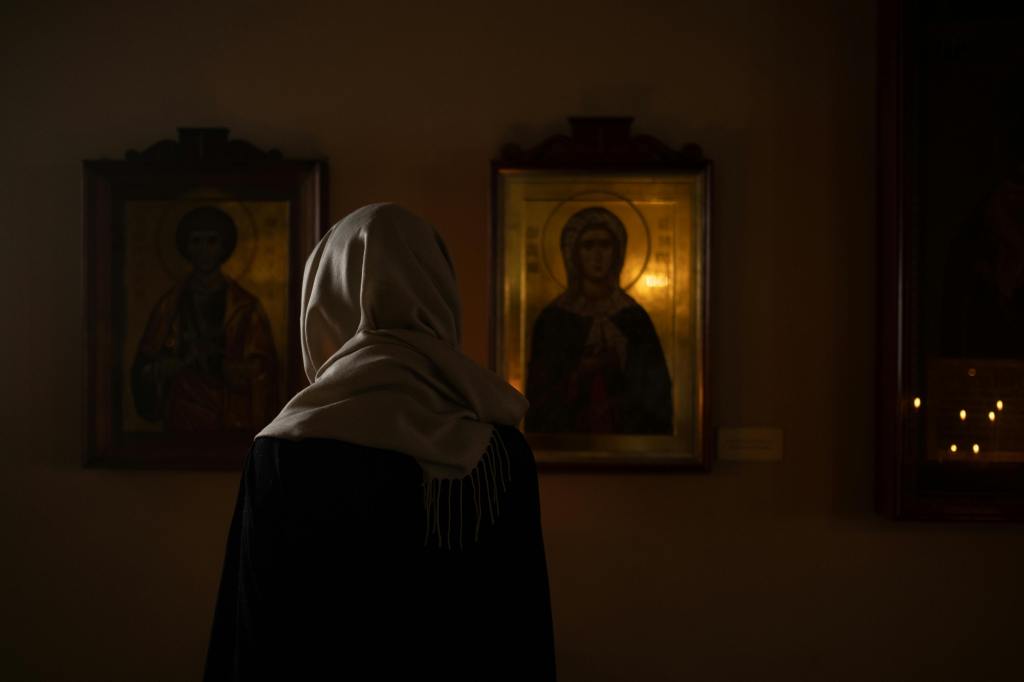
“Today, in the midst of so many dangers that we live, God protects us like a mother protects a young child, when it begins to walk. Now, Jesus Christ, Virgin Mary and the Saints help us the most, but we do not understand it. Imagine how the world would be, if they did not help! ” St. Paisios
Imagine a man who prayed to God for cancer, not to be healed from it, but to receive it in place of another person who was suffering from it. That man was Saint Paisios of Mount Athos, a modern-day Orthodox monk whose life was marked by faith, miracles, and a desire to serve people by taking on their burdens. When St. Paisios’s health began rapidly declining, his parishioners begged him to ask God for healing because the cancer was spreading throughout his body. St. Paisios refused. He said he could not deceive God because he had asked him for this disease. And once God gave it to him, he could not ask Him to take it away.
That is a kind of devotion and surrender that is rarely seen in the modern world today. There is a reason why Saint Paisios was honored as a saint, because this type of faith only comes from the throneroom of our Lord.
Stories of Orthodox saints like Paisios remind me how little most of us in the West understand about suffering. That is not to dismiss or diminish the real pain and struggles people face here, like illness, death, financial crisis, and natural disasters, which are all valid. But for the most part, the scale and depth of suffering many Christians around the world endure for the sake of their faith is not compared to what we go through here in the West.
Many times, when I feel frustrated with the Evangelical Church and its inability to sympathize with the suffering of people around the world, I have to pause and remember that it is hard to feel sympathy for something you have never experienced. I understand. I cannot force people to have certain emotions. I cannot force people to love God more than they love themselves.
It is also difficult to sympathize with people whose cultures feel foreign and whose ways of thinking and living are very different from the Western mindset. Human beings are tribal. They like to stick with what feels comfortable and familiar. We often side with those we consider “our own” or “one of us.” We naturally gravitate toward and trust those who share our skin color, heritage, ethnicity, language, and traditions because familiarity often feels safer than truth.
This is why the Gospel is revolutionary. It tore down every racial, cultural, and linguistic barrier. It stopped defining you by your earthly identity. You become a new creation, a child, a member of “the Way.” You are part of a chosen people, set apart to live differently from the rest of the world, where Christ welcomes all because He created all. It makes sense why God would want all of His children. God’s jealous love for His creation burns with fury when He sees souls fall into the hands of the enemy. But because His love cannot exist without free will, He lets you go, because agape never demands forced obedience.
In the West, we rationalize our suffering. Empathy is either glorified without holiness or completely dismissed. One side insists empathy is the highest virtue, while the other side argues it must be eradicated because it has corrupted our society. And so, we fight and fight, with no reconciliation in sight. No wonder we struggle to suffer. We are lost, unsure of which emotions we are even allowed to feel.
We are the most medicated, sick, lonely, and obese nation in the world. We have so much, yet feel like we have nothing at all. We have made Jesus in our own image, forgetting what it means to follow the Master of the Way, who told us not to take an extra bag when sharing the good news, not to worry about what to eat, drink, or wear. We have forgotten when He told us not to be anxious about anything, to rejoice in the face of trials, and to look forward to the everlasting joy of the new heavens and the new earth.
We do not know how to suffer because we do not want to suffer. We suffer silently. We suffer publicly online. We are numb, desensitized, and spiritually poor. We chase the things of this world and are surprised when our souls begin to ache. The enemy has trapped us in our individualist bubbles, and at times when we manage to get out, we find ourselves in an empty room, alone with no one there.
We write, we poll, we report on the state of our society. The cure is always community. The cure is always other people. But we can’t seem to get it together, even the church, even the body of Christ that is supposed to be the glue.
Capitalism is forcing isolation. Who said it is supposed to be this way? Christ came to free us. Why are we living in self-made prisons? They say that it is the best system for human flourishing, but all I see is suffering wrapped in comfort. If only we understood the blessings hidden in every tear we shed when tragedy strikes. If only we knew, we would suffer much better.
I do not want Christians to glorify pain. Tragedies need prayer and action. Humans were never meant to suffer. But we do, and while we are here, let us do that knowing the battle has been won. And it is only a matter of time before divine justice takes place.
The story of Saint Paisios shows us that God’s kingdom advances through pain. It does not advance through money, marketing plans, or strategies, but through faithful and surrendered lives. The saints remind us that our devotion to the plans of the Kingdom of God is what changes the world.
We need Christ.
Let us suffer well. Let us suffer with Christ.
 Fariza
Leave a comment